Cytokines Mesotherapy and Exosome-based products are both positioned as advanced approaches for professional hair and scalp care. Although both are associated with cellular signaling, dermal papilla cells, hair-follicle support, and professional delivery procedures, their manufacturing models are fundamentally different.
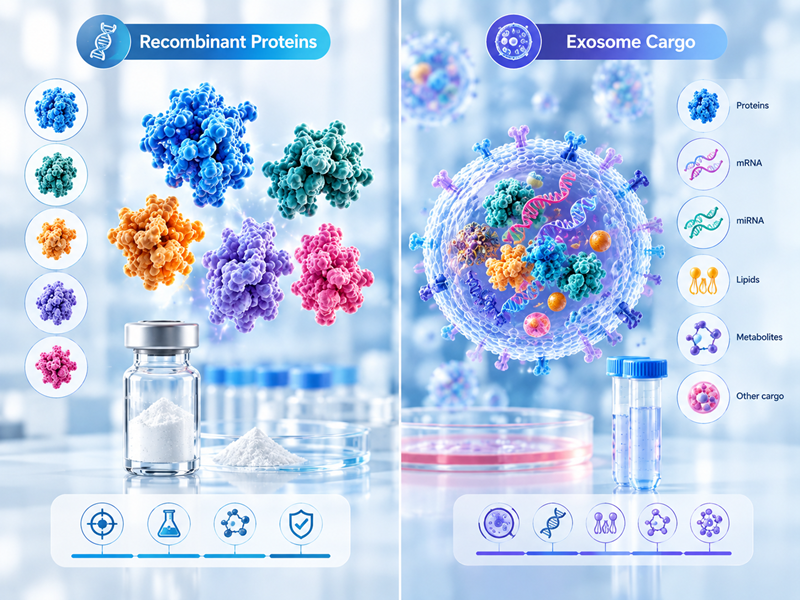
A recombinant protein formulation is created by selecting and combining identified proteins. An Exosome-based preparation is created by culturing living cells and collecting the extracellular vesicles they release.
For distributors, this difference affects product documentation, quality control, supplier evaluation, storage, clinical claims, regulatory review, and sales education.
1. Component-Defined vs Process-Defined
Recombinant Protein-Based Products
The manufacturer begins with selected protein targets.
The general process is:
1. Select the proteins.
2. Produce each protein through biotechnology.
3. Purify and test the proteins.
4. Combine them into a defined formulation.
5. Control concentration, purity, potency, and stability.
This is a component-defined approach.
The manufacturer may specify:
• Which proteins are included
• The concentration of each protein
• Supporting ingredients
• Purity standards
• Biological-activity standards
• Storage and reconstitution conditions
This makes product explanation, ingredient comparison, technical training, and batch evaluation relatively straightforward.
However, defined composition does not automatically prove clinical effectiveness. The proteins must also remain active, stable, appropriately delivered, and supported by relevant evidence.
Exosome-Based Products
Exosome-based products begin with living source cells.z
The process generally includes:
1. Selecting and culturing the cells
2. Collecting Conditioned Media
3. Separating extracellular vesicles
4. Purifying and characterizing the preparation
5. Formulating and storing the final product
This is a process-defined approach.
The final product may be influenced by:
• Source-cell type
• Donor
• Cell passage
• Culture medium
• Oxygen conditions
• Cell density
• Collection timing
• Separation method
• Purification
• Storage
For this reason, two products described as “Exosomes” should not automatically be considered equivalent.

2. Composition: Defined Signals vs Complex Cargo
Recombinant protein formulations usually contain selected proteins and supporting ingredients. The manufacturer may be able to identify the name and amount of each major recombinant component.
Exosome-based preparations may contain complex biological cargo such as:
– Proteins
– Lipids
– Messenger RNA
– MicroRNA
– Metabolites
– Other cell-derived materials
This complexity may allow multiple biological signals to be delivered together, but it also makes the complete active composition more difficult to define, quantify, and compare.
Complexity does not automatically mean superiority.
3. Quantity Is Not the Same as Biological Activity
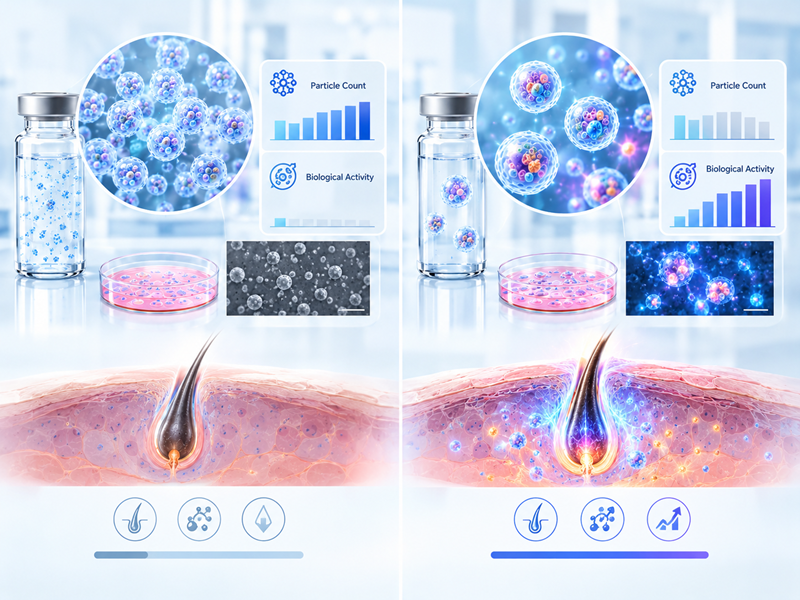
Recombinant proteins may be quantified directly in nanograms, micrograms, concentration per milliliter, or biological-activity units.
Exosome-based products may be described by:
• Particles per milliliter
• Particles per vial
• Total protein
• Selected cargo
• Functional potency
Particle count is useful, but it does not directly indicate biological activity.
Two products with the same particle count may differ in:
• Purity
• Cargo
• Source cells
• Potency
• Stability
Therefore, a high particle number should not be treated as proof of superior quality.
4. Purity and Potency
The two product categories have different impurity profiles.
Recombinant Protein Products
Potential impurities may include:
• Host-cell proteins
• Host-cell DNA
• Protein aggregates
• Degraded protein fragments
• Endotoxin
• Residual processing materials
Exosome-Based Products
Potential impurities may include:
• Soluble proteins
• Lipoproteins
• Protein aggregates
• Cell debris
• Residual DNA
• Culture-medium components
• Non-vesicular particles
• Processing residues
High concentration does not necessarily mean high purity.
Potency is also essential. A protein may be present but inactive, while an Exosome particle may be counted but biologically weak.
Distributors should confirm whether biological activity is measured and whether potency is used to compare commercial batches.

5. Batch-to-Batch Consistency
Professional distribution requires reproducible production.
For recombinant protein products, batch control may include:
• Protein identity
• Concentration
• Purity
• Potency
• Aggregate level
• Sterility
• Stability
Because the intended components are predetermined, component-specific specifications can be established.
For Exosome-based products, additional variables may need to be controlled:
• Source-cell identity
• Passage number
• Cell viability
• Particle count
• Particle size
• Marker profile
• Purity
• Residual DNA
• Potency
• Sterility
• Stability
This does not mean Exosome products cannot be standardized, but they generally require a broader manufacturing-control system.

6. Stability, Storage, and Scale-Up
Both recombinant proteins and extracellular vesicles are sensitive biological materials.
Recombinant proteins may be affected by heat, moisture, oxidation, aggregation, light, pH changes, and repeated freezing and thawing.
Exosome preparations may be affected by:
• Membrane disruption
• Particle aggregation
• Cargo degradation
• Changes in particle size
• Loss of biological potency
• Freeze-thaw damage
Both product types may be supplied as lyophilized powders, but freeze-drying itself does not prove quality or stability.
Product-specific stability data should support:
• Storage temperature
• Shelf life
• Shipping conditions
• Reconstitution
• Freeze-thaw restrictions
• Stability after opening
Commercial scale-up should also be validated. A laboratory-scale process does not automatically guarantee consistent commercial manufacturing.

7. Safety Depends on the Delivery Route
Neither product category is automatically safe simply because it is biological or cell-free.
Potential risks differ between recombinant proteins and Exosome-based products, but in both cases the safety requirements depend strongly on the intended route:
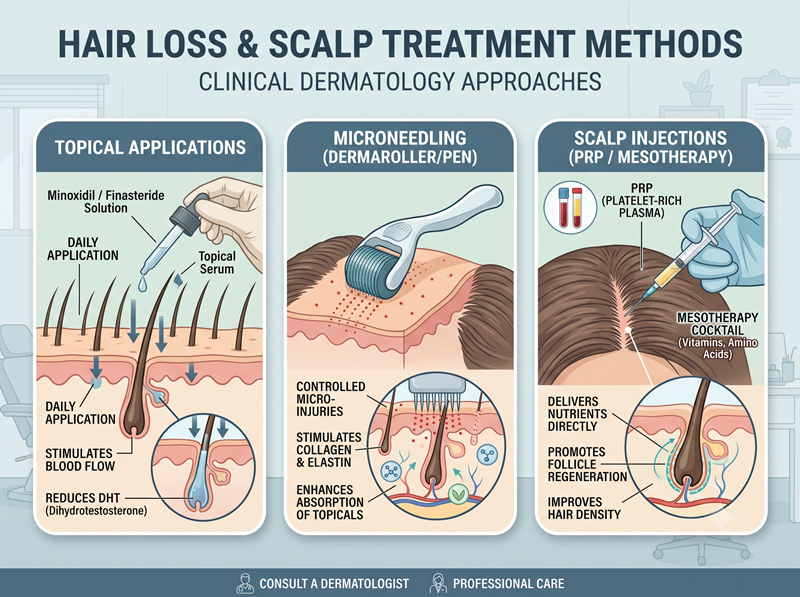
• Topical use
• Microneedling
• Electroporation
• Mesotherapy
• Injection
Evidence for one route should not automatically be applied to another.
8. Clinical Evidence: Technology Evidence vs Product
Evidence
Distributors should distinguish among three types of evidence.
Technology Evidence
General research on recombinant proteins, growth factors, EVs, or Exosomes.
Product Evidence
Research using the exact final commercial formulation.
Protocol Evidence
Research using the product with a specific dose, delivery method, frequency, and patient group.
Product and protocol evidence are more relevant for commercial claims.
For example:
• Evidence for one growth factor does not prove every multi-protein formulation.
• Evidence for adipose-derived EVs does not prove an umbilical cord-derived product.
• Evidence from microneedling cannot automatically support topical application alone.

9. AGF39™ as a Component-Defined Example
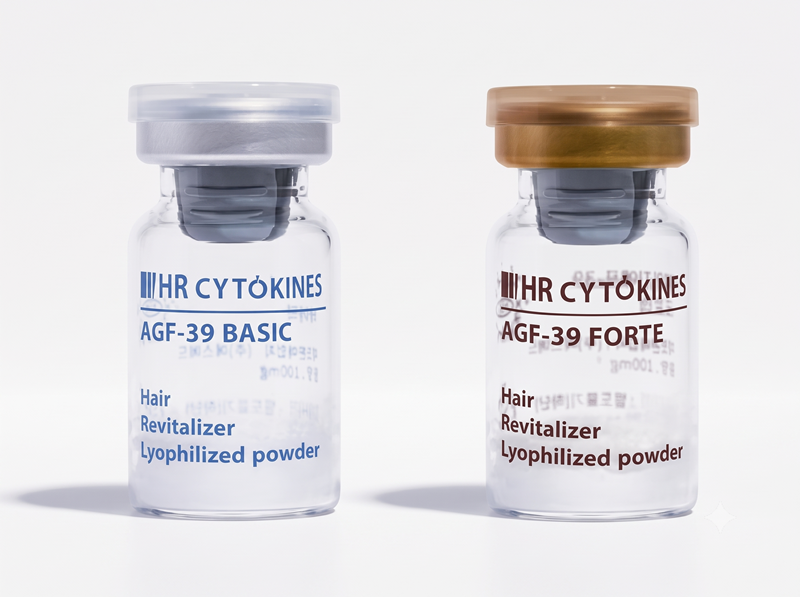
AGF39™ is AesMed’s recombinant protein-based formulation developed for professional hair and scalp applications.
Its recombinant protein components include:
• KGF
• IGF-1
• VEGF
• bFGF
• Noggin
• FGF9
• SOD
The formulation also includes amino acids, vitamins, minerals, ATP, glutathione, coenzyme-related ingredients, and other supporting components.
AGF39™ is supplied in a lyophilized format and illustrates the component-defined manufacturing model.
For distributors, this allows structured evaluation of:
• Identified protein components
• Product specifications
• Potency
• Stability
• Reconstitution
• Recommended delivery method
• Clinical documentation
• Regulatory documentation
However, defined composition does not replace the need for clinical evidence.
10. Direct Comparison
| Evaluation Area | Recombinant Protein-Based Product | Exosome-Based Product |
| Starting point | Selected proteins | Living source cells |
| Product model | Component-defined | Process-defined |
| Composition | Predetermined proteins | Complex vesicles and cargo |
| Main quantity | Protein concentration | Particle, protein, cargo, or potency units |
| Identity testing | Protein-specific | Multiple particle, marker, and source tests |
| Main impurities | Host-cell proteins, DNA, aggregates, endotoxin | Soluble proteins, lipoproteins, DNA, debris, non-vesicular particles |
| Potency | Protein- or formulation-specific assay | Product-specific functional assay |
| Batch control | Component specifications | Cell and process specifications |
| Stability focus | Protein structure and activity | Particle integrity, cargo, and activity |
| Main strength | Defined and measurable components | Complex cell-derived signaling |
| Main challenge | Linking selected proteins to clinical outcomes | Standardizing heterogeneous biological material |
This comparison describes general characteristics only. The actual quality of each product should be reviewed separately.

11. Distributor Due-Diligence Checklist
Before selecting either product category, distributors should confirm:
• What exactly is supplied?
• Are the active components or source cells disclosed?
• Is the manufacturing process clearly explained?
• Which impurities are controlled?
• How is the active material quantified?
• Is biological potency tested?
• Are storage and shelf life supported by data?
• Are multiple production batches comparable?
• Was the exact final product clinically studied?
• Does the recommended delivery method match the evidence?
• Is the product correctly classified in the target market?
• Are the proposed claims and delivery route permitted?

Commercial Red Flags
Additional verification is warranted when a supplier:
• Uses only broad terms such as “growth factors” or “Exosomes”
• Does not disclose protein identity or source cells
• Provides only ingredient count or particle count
• Provides no potency information
• Cannot explain purification
• Provides only one batch certificate
• Uses research from an unrelated product
• Claims universal superiority
• Promotes injection without route-specific documentation
• Cannot provide stability or shipping data
Key Takeaway
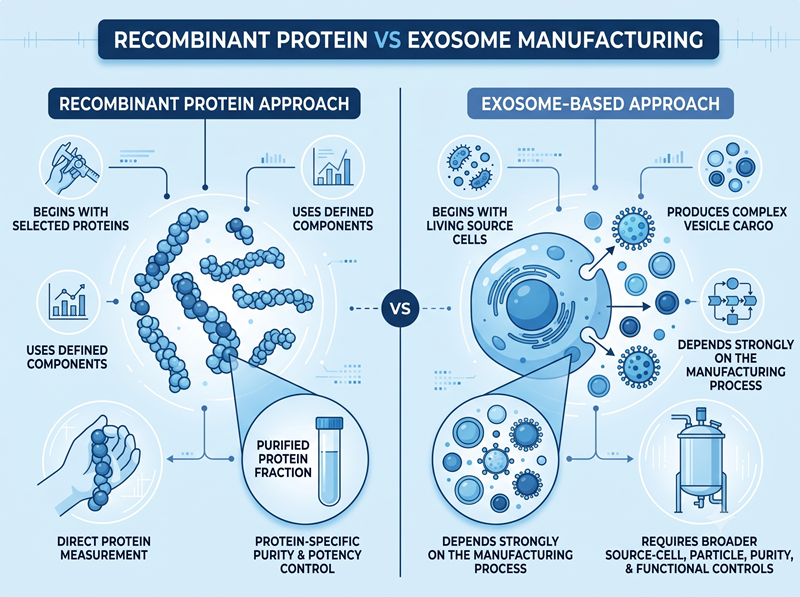
Recombinant protein-based and Exosome-based products are built through fundamentally different manufacturing models.
Recombinant Protein-Based Approach
• Begins with selected proteins
• Uses defined components
• Allows direct protein measurement
• Supports protein-specific purity and potency control
Exosome-Based Approach
• Begins with living source cells
• Produces complex vesicle cargo
• Depends strongly on the manufacturing process
• Requires broader source-cell, particle, purity, and functional controls
For distributors, neither technology should be selected because it sounds more advanced.
The more important question is:
What exactly is in the product, how consistently can it be manufactured, and does the clinical evidence support the claims being made?
The stronger commercial product is the one that offers the clearest, most consistent, and most verifiable technical package.
Medical and Regulatory Disclaimer
This article is provided for scientific, educational, and business-information purposes only. It does not constitute medical advice, diagnosis, a treatment recommendation, or confirmation of regulatory approval.
Recombinant protein and Exosome-based products may differ substantially in composition, manufacturing, quality, safety, permitted claims, delivery methods, and regulatory classification.
Distributors and healthcare professionals should review current product-specific technical, clinical, and regulatory documentation before commercialization or professional use.
“Some of the images were created using Chatgpt and Gemini.”