The professional hair-growth market includes a growing number of products described as:
– Cytokines Mesotherapy for Alopecia
– Recombinant growth-factor formulations
– Exosome-based products
– Extracellular-vesicle products
– Stem Cell Conditioned Media
– Secretome solutions
These products may share a similar commercial message: supporting cellular signaling around the hair follicle.
However, they differ significantly in:
• Composition
• Biological source
• Manufacturing process
• Quality-control methods
• Delivery protocol
• Clinical evidence
• Regulatory status
For distributors, the final decision should not be based only on product trends, particle numbers, ingredient counts, or promotional language.
The central question is:
Can the supplier clearly demonstrate what the product is, how it is controlled, how it should be used, and what evidence supports its commercial claims?
This final article provides a practical framework for evaluating both Cytokines Mesotherapy and Exosome-based hair products.

Step 1: Define the Intended Market
Before reviewing the technology, determine how the product will be positioned.
Possible target customers include:
• Dermatology clinics
• Hair-restoration clinics
• Hair-transplant centers
• Medical aesthetic clinics
• Professional scalp-care centers
• Hospitals
• Cosmetic distributors
The intended market affects:
• Product classification
• Permitted claims
• Required documentation
• Professional-use restrictions
• Pricing
• Training
• Distribution channels
A product suitable for cosmetic scalp care may not automatically be suitable for medical mesotherapy or injection.
The target customer and intended use should therefore be defined before signing a distribution agreement.

Step 2: Identify the Exact Product Category
The distributor should confirm whether the product is:
• A recombinant protein formulation
• A Cytokines Mesotherapy product
• A purified extracellular-vesicle preparation
• An EV-enriched product
• Conditioned Media
• Stem Cell Conditioned Media
• Secretome
• A finished serum containing several active materials
These terms should not be used interchangeably.
For example:
• Exosomes are not stem cells.
• Exosomes are not the entire Secretome.
• Conditioned Media is not automatically a purified Exosome preparation.
• A recombinant protein formulation is not the same as a cell-derived mixture.
An unclear product definition creates risks for regulatory review, training, marketing, and customer trust.

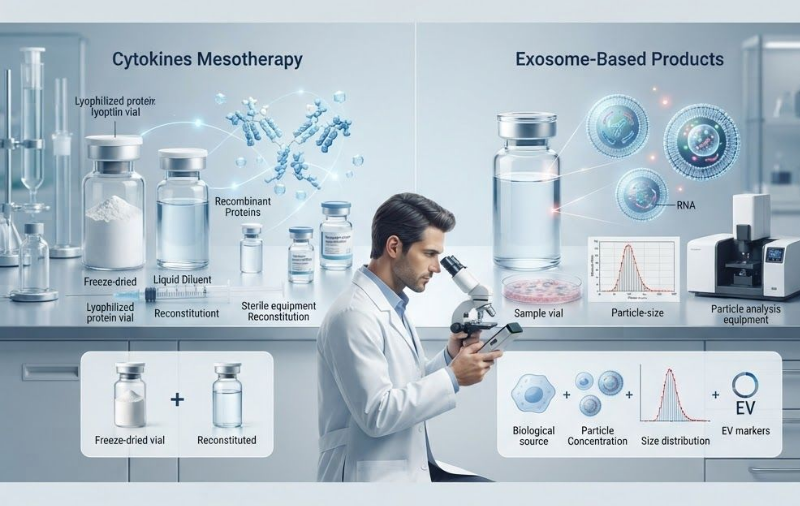
Step 3: Confirm What the Product Contains
For Cytokines Mesotherapy Products
Request:
• Exact recombinant protein names
• Protein quantities or specifications
• Supporting ingredients
• Product concentration
• Liquid or lyophilized format
• Recommended diluent
• Reconstitution instructions
Terms such as “growth-factor complex” or “multiple cytokines” are not sufficiently specific.
For Exosome-Based Products
Request:
• Exact source cell
• Tissue origin
• Human, animal, plant, or other source
• Product type: EVs, Exosomes, Conditioned Media, or Secretome
• Particle concentration
• Particle-size distribution
• EV-related markers
• Supporting ingredients
A large particle number does not replace a complete product description.
Step 4: Review the Manufacturing Model
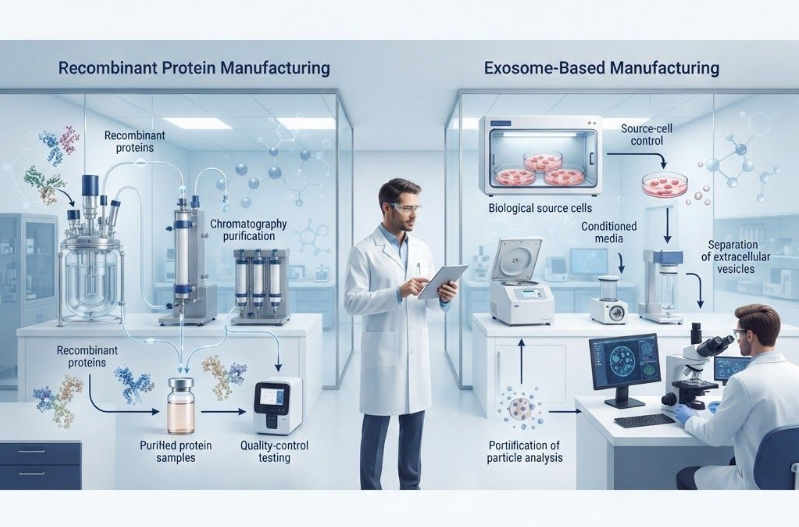
The two product categories require different questions.
Recombinant Protein Manufacturing
The supplier should explain:
1. How the proteins are produced
2. How they are purified
3. How the individual proteins are identified
4. How the final formulation is blended
5. How each batch is tested
The main quality focus is controlling identified molecular components.
Exosome-Based Manufacturing
The supplier should explain:
1. Which source cells are used
2. How the cells are cultured
3. How Conditioned Media is collected
4. How extracellular vesicles are separated
5. How the preparation is purified
6. How the particles and biological activity are tested
The main quality focus is controlling the source cells and complete manufacturing process.
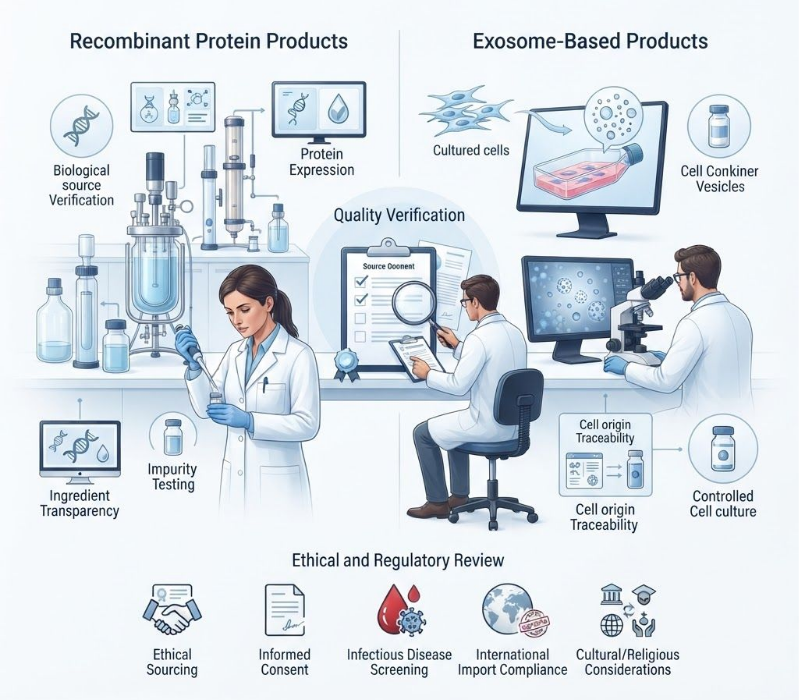
Step 5: Evaluate the Source Materials
Recombinant Protein Products
Important source questions include:
• Which biological expression systems are used?
• Are animal- or human-derived processing materials used?
• Are host-cell impurities controlled?
• Are supporting ingredients fully disclosed?
Exosome-Based Products
Important source questions include:
• Which cells produce the vesicles?
• Where were the cells obtained?
• Is the source traceable?
• Is donor screening performed when relevant?
• Is a controlled cell bank used?
• What cell passage range is permitted?
For human-derived products, the distributor may also need to review:
• Ethical procurement
• Informed consent
• Infectious-disease screening
• Import requirements
• Religious or cultural concerns
Step 6: Check Purity
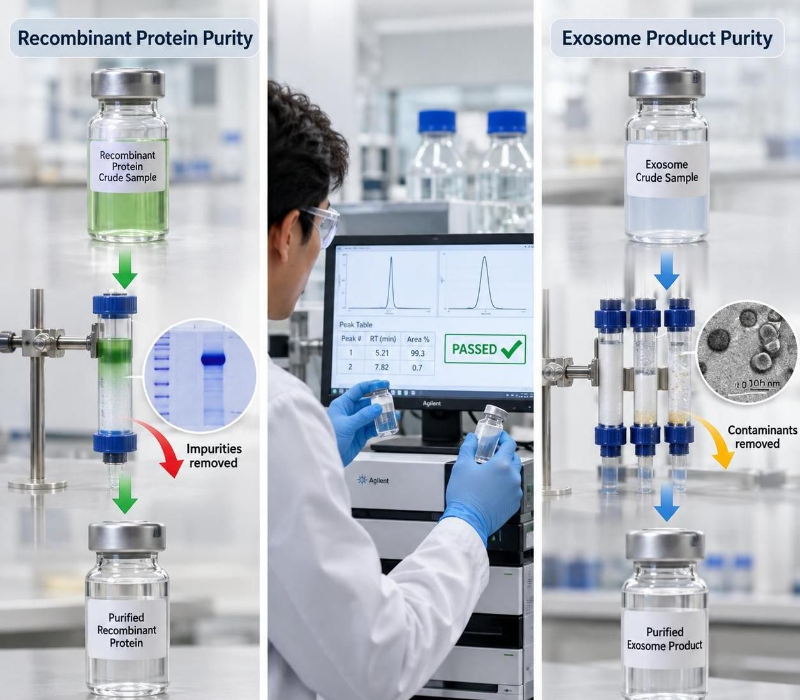
A product should be evaluated not only by what it contains but also by what has been removed.
Potential Recombinant Protein Impurities
• Host-cell proteins
• Host-cell DNA
• Protein aggregates
• Degraded proteins
• Endotoxin
• Residual processing materials
Potential Exosome Product Impurities
• Soluble proteins
• Lipoproteins
• Cell debris
• Residual DNA
• Culture-medium materials
• Non-vesicular particles
• Processing reagents
The supplier should provide:
• Relevant test results
• Product specifications
• Acceptance criteria
• Batch-specific certificates
High concentration does not automatically mean high purity.
Step 7: Confirm How the Active Material Is Measured
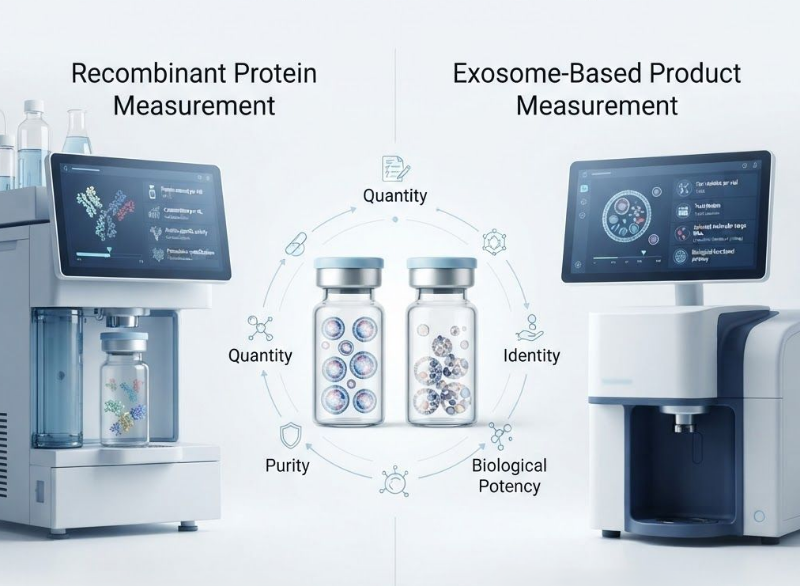
Recombinant Proteins
Useful measurements may include:
• Amount per vial
• Concentration per milliliter
• Protein-specific activity
• Final formulation specifications
Exosome-Based Products
Useful measurements may include:
• Particles per milliliter
• Particles per vial
• Total protein
• Selected cargo
• Functional potency
Particle count should not be used as the only product-quality indicator.
Two products reporting the same particle count may have different:
• Cell sources
• Purity
• Cargo
• Biological activity
• Stability
Quantity should always be reviewed together with identity, purity, and potency.
Step 8: Ask for Potency Data
Potency means that the product can produce an intended biological response.
Recombinant Protein Potency
The manufacturer may test:
• Receptor interaction
• Enzyme activity
• Cell response
• Hair-related signaling activity
Exosome Product Potency
The manufacturer may test:
• Dermal papilla cell response
• Cell proliferation
• Cell migration
• Oxidative-stress protection
• Vascular or hair-related signaling
The distributor should ask:
• Is the potency test quantitative?
• Is it connected to the product’s intended function?
• Is it used only during development or for every commercial batch?
• Are results consistent among batches?
A product may contain the intended proteins or particles while having low biological activity.

Step 9: Review Stability and Logistics
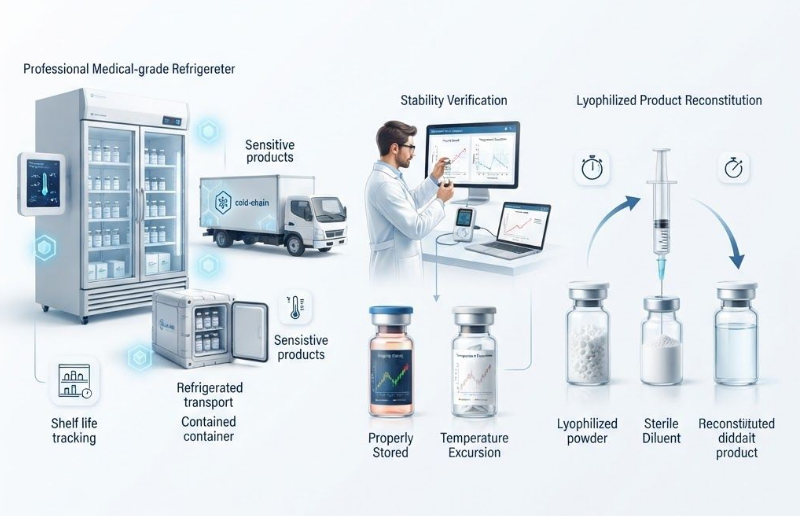
Biological products can lose quality during storage and transportation.
Request information on:
• Storage temperature
• Shelf life
• Cold-chain requirements
• Temperature-excursion limits
• Freeze–thaw restrictions
• Light protection
• Reconstitution
• Stability after opening
Lyophilized Products
For freeze-dried products, confirm:
• Recommended diluent
• Reconstitution time
• Stability after reconstitution
• Storage after preparation
• Product recovery
• Potency throughout shelf life
A lyophilized format may offer logistical advantages, but it does not automatically guarantee biological stability.
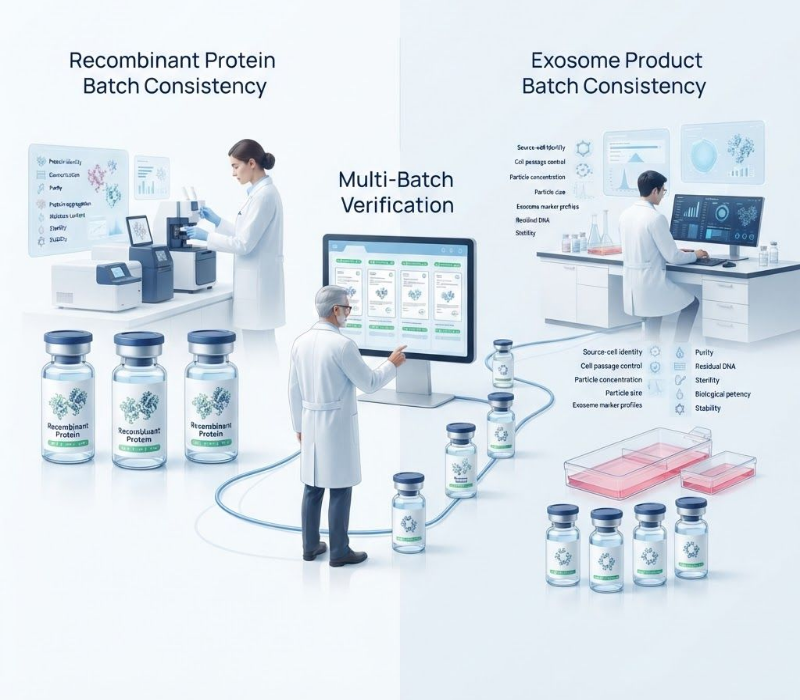
Step 10: Confirm Batch Consistency
A product intended for distribution must be consistent across repeated production runs.
Recombinant Product Batch Controls
May include:
• Protein identity
• Concentration
• Purity
• Potency
• Aggregation
• Moisture
• Sterility
• Stability
Exosome Product Batch Controls
May include:
• Source-cell identity
• Cell passage
• Particle concentration
• Particle size
• Marker profile
• Purity
• Residual DNA
• Potency
• Sterility
• Stability
The distributor should review certificates from more than one batch.
A single successful batch does not prove long-term supply consistency.
Step 11: Evaluate Safety Documentation
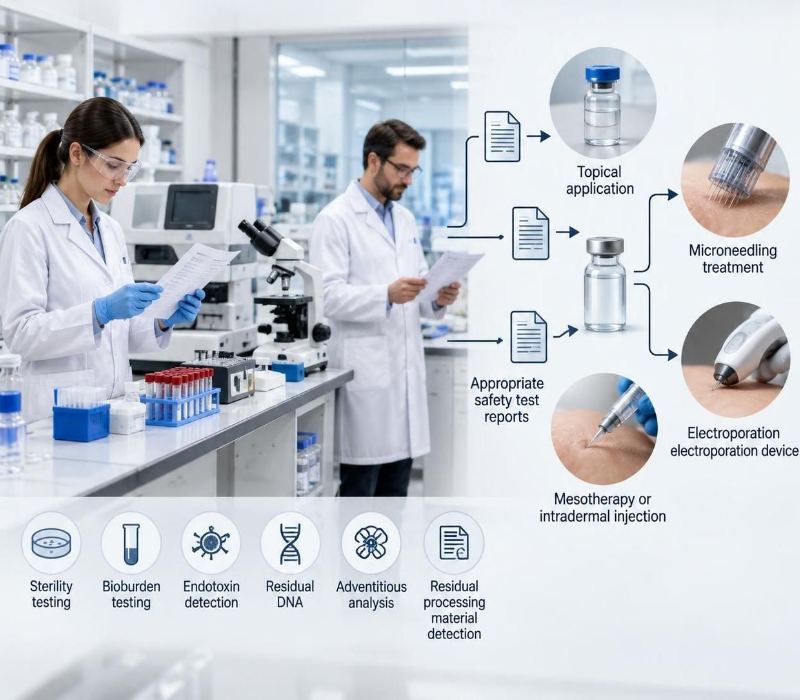
Relevant safety testing may include:
• Sterility
• Bioburden
• Endotoxin
• Mycoplasma
• Residual DNA
• Adventitious agents
• Residual processing materials
The required testing depends on the intended route.
A product used topically may require a different safety package from one intended for:
• Microneedling
• Electroporation
• Mesotherapy
• Intradermal injection
Safety evidence for one route should not automatically be applied to another.
Step 12: Review the Delivery Protocol
The delivery method affects both performance and regulatory risk.
Possible methods include:
• Topical application
• Microneedling
• Mesotherapy
• Manual injection
• Mesogun
• Electroporation
• Energy-assisted delivery
A complete professional protocol should define:
• Product dose
• Dilution or reconstitution
• Device or needle
• Delivery depth
• Treated area
• Session interval
• Number of sessions
• Aftercare
• Evaluation schedule
The distributor should verify that the product is compatible with the recommended method.
Evidence for microneedling should not automatically support injection or electroporation.
Step 13: Confirm Product–Device Compatibility
When a device is used, ask:
• Which model is recommended?
• What settings should be used?
• Is compatibility testing available?
• Is the product stable during delivery?
• Is operator training provided?
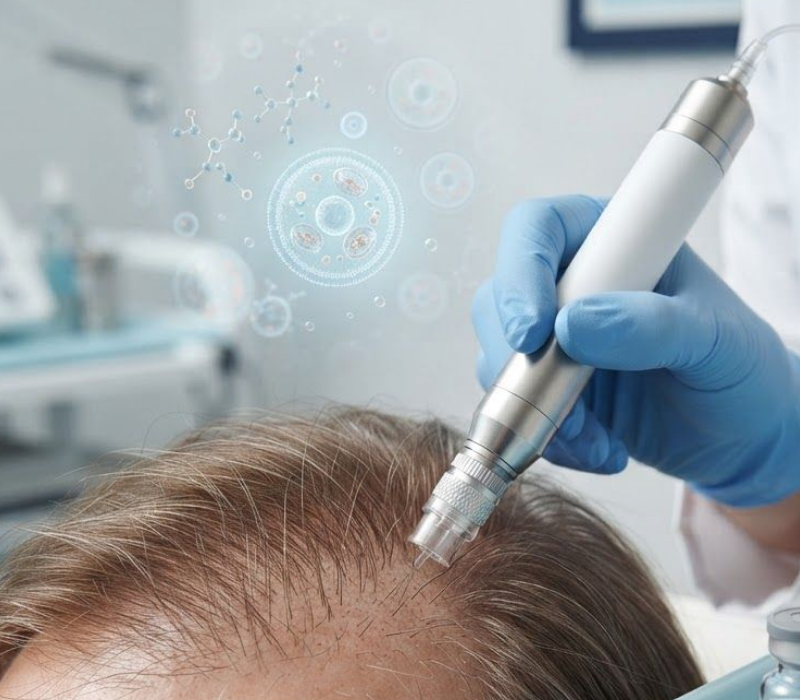
For recombinant proteins, device-related stress may affect protein activity.
For extracellular vesicles, the procedure may affect:
• Vesicle membranes
• Particle aggregation
• Cargo stability
• Biological potency
The formulation and device should be evaluated as one commercial system when they are intended to be used together.
Step 14: Assess the Clinical Evidence
Clinical evidence should match:
• The exact final product
• The intended hair-loss condition
• The recommended dose
• The recommended delivery method
• The treatment schedule
Ask:
• Was the study performed in humans?
• Was the diagnosis clearly defined?
• Was there a control group?
• Was the sample size adequate?
• Were objective hair measurements used?
• Were photographs standardized?
• Was follow-up long enough?
• Were adverse events reported?
Laboratory research supports the biological concept.
It does not independently prove commercial effectiveness in patients.

Step 15: Separate Ingredient Evidence from Product Evidence
Evidence may exist at three levels.
Ingredient Evidence
Research involving one protein, molecule, or biological signal.
Product Evidence
Research involving the complete final formulation.
Protocol Evidence
Research involving the product, dose, delivery method, and treatment schedule.
For commercial claims, product and protocol evidence are the most relevant.
Examples:
• VEGF research does not prove every VEGF-containing formulation.
• General Exosome research does not prove every commercial Exosome product.
• Microneedling research does not prove the product’s independent effect.
The claim should match the actual level of evidence.

Step 16: Verify Regulatory Status
The distributor should confirm:
• Product classification
• Product registration or notification
• Import requirements
• Labeling requirements
• Permitted claims
• Authorized route
• Professional-use restrictions
• Device registration
• Advertising rules
The same product may be classified differently in different countries.
Terms such as “Exosome,” “growth factor,” or “cell-free” do not establish regulatory approval.
A supplier’s approval in one market does not automatically permit distribution or the same claims in another.

Step 17: Review the Supplier’s Commercial Capability
Technical quality is essential, but distributors should also evaluate business reliability.
Important questions include:
• Can the supplier provide consistent volume?
• Is commercial-scale production validated?
• What is the normal lead time?
• Is a cold chain required?
• What is the minimum order quantity?
• How are product complaints handled?
• Is technical training available?
• Are marketing materials compliant?
• Will manufacturing changes be communicated?
• Is adverse-event support available?
A promising product may still create commercial problems if the supplier cannot support stable international distribution.

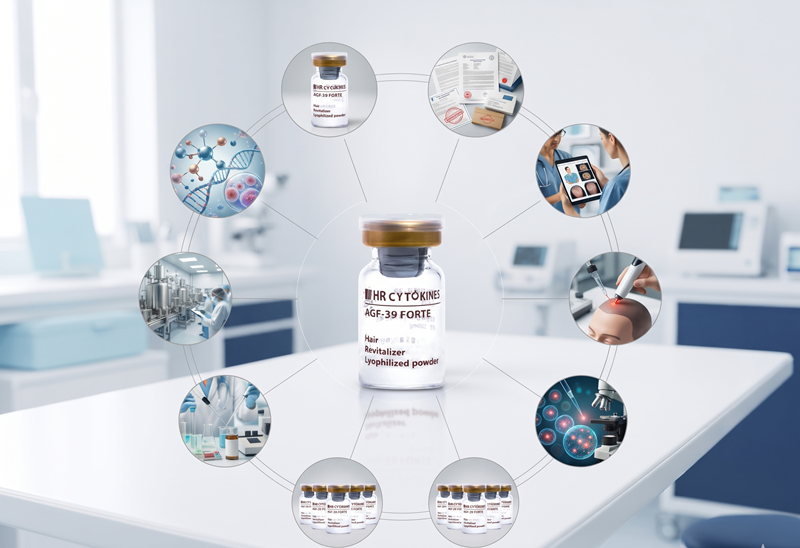
Step 18: Request a Complete Documentation Package
The distributor should request more than a brochure.
Product Documents
• Product specifications
• Ingredient or source information
• Instructions for use
• Certificate of Analysis
• Storage requirements
• Shelf-life information
Manufacturing Documents
• Manufacturing overview
• Quality-control process
• Purification information
• Batch-release criteria
Safety Documents
• Sterility
• Endotoxin
• Mycoplasma
• Route-specific safety information
Clinical Documents
• Published studies
• Clinical reports
• Study protocols
• Product-specific results
Regulatory Documents
• Registration or notification
• Product classification
• Permitted claims
• Device documentation
No single certificate can replace the full technical and regulatory package.

Common Commercial Red Flags
Additional verification is needed when a supplier:
• Cannot clearly define the product
• Uses Exosome, Secretome, and Conditioned Media as identical terms
• Discloses only ingredient count or particle count
• Does not identify source cells
• Provides no potency information
• Cannot explain purification
• Has data from only one production batch
• Uses research from a different product
• Recommends injection without route-specific documentation
• Claims guaranteed or permanent hair growth
• Cannot provide stability or shipping information
• Does not notify distributors of manufacturing changes
These issues may increase regulatory, reputational, and financial risk.
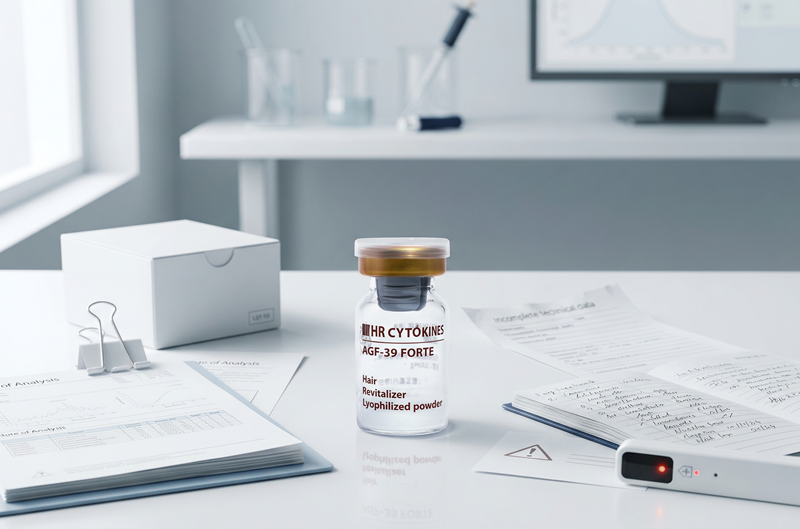
AGF39™ as a Defined Cytokines Mesotherapy Example
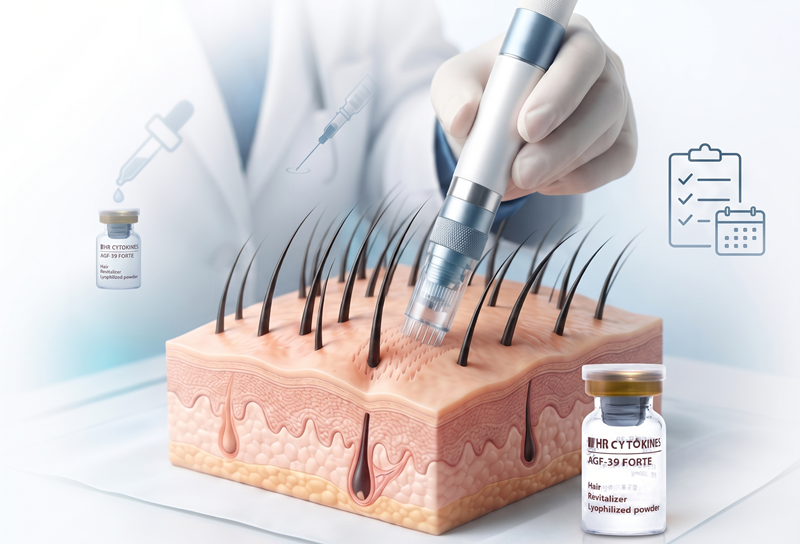
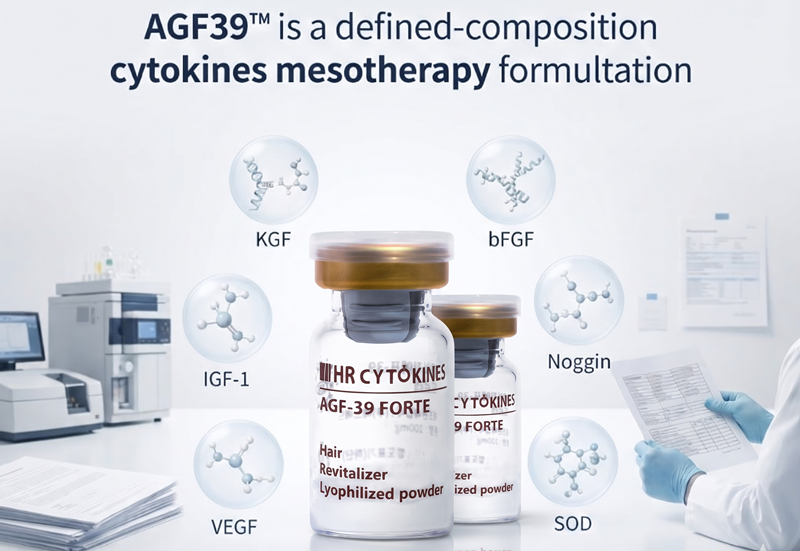
AGF39™ is AesMed’s recombinant protein-based formulation developed for professional hair and scalp applications.
Its recombinant protein components include:
• KGF
• IGF-1
• VEGF
• bFGF
• Noggin
• FGF9
• SOD
It also contains amino acids, vitamins, minerals, ATP, glutathione, coenzyme-related ingredients, and other supporting components.
AGF39™ is supplied as a lyophilized formulation and represents a defined-composition model.
When evaluating AGF39™ or another Cytokines Mesotherapy product, distributors should review:
• Identified ingredients
• Product quality specifications
• Potency
• Stability
• Reconstitution
• Professional-use protocol
• Clinical documentation
• Local regulatory status
Defined composition makes structured evaluation possible, but it does not replace product-specific clinical evidence.
Final Comparison
| Evaluation Area | Cytokines Mesotherapy Product | Exosome-Based Product |
| Starting point | Selected recombinant proteins | Living source cells |
| Product definition | Identified components | Source cells, process, vesicles, and cargo |
| Main quantity | Protein concentration | Particle, protein, cargo, or potency |
| Quality focus | Protein identity, purity, and activity | Source-cell, particle, purity, and functional controls |
| Main variability | Protein production and formulation | Cell culture and multistep manufacturing |
| Stability focus | Protein activity | Vesicle integrity, cargo, and potency |
| Main documentation | Ingredient and protein specifications | Cell-source, process, and characterization data |
| Commercial strength | Clear component explanation | Complex multi-signal positioning |
| Main commercial challenge | Proving final-formulation performance | Explaining and standardizing biological |

A 10-Point Distributor Decision Checklist
Before final product selection, confirm the following.
1. Product Definition
Can the supplier clearly explain what the product is?
2. Composition or Source
Are the proteins, cells, vesicles, and supporting ingredients disclosed?
3. Manufacturing
Is the production and purification process controlled?
4. Purity
Are relevant unwanted materials measured?
5. Potency
Is biological activity demonstrated?
6. Stability
Are shelf life, storage, transportation, and reconstitution supported?
7. Batch Consistency
Are several commercial batches comparable?
8. Clinical Protocol
Is the dose, delivery method, and treatment schedule defined?
9. Clinical Evidence
Does the evidence support the exact product and recommended protocol?
10. Regulatory and Commercial Readiness
Can the product be legally and consistently supplied in the target market?
A product does not need to be identical to every competitor.
It needs to be clearly defined, responsibly supported, and commercially manageable.
Key Takeaway
Cytokines Mesotherapy and Exosome-based products represent two different approaches to hair-follicle signaling.
Cytokines Mesotherapy Products
• Use selected recombinant proteins
• Offer defined composition
• Allow more direct component measurement
• Require protein quality, stability, and formulation evidence
Exosome-Based Products
• Begin with living source cells
• Deliver complex extracellular-vesicle cargo
• Depend strongly on manufacturing conditions
• Require broader source-cell, particle, purity, and potency controls
Neither technology should be selected solely because it sounds more advanced.
The stronger distribution opportunity is the product that can provide clear and verifiable information on:
1. Identity
2. Composition or biological source
3. Manufacturing
4. Purity
5. Quantity
6. Potency
7. Stability
8. Batch consistency
9. Safety
10. Delivery protocol
11.Clinical evidence
12. Regulatory status
13. Commercial supply
For distributors, scientific understanding is not separate from business strategy.
It is the foundation for selecting reliable products, training professional customers, managing regulatory risk, and building sustainable market trust.

Medical and Regulatory Disclaimer
This article is provided for scientific, educational, and business-information purposes only. It does not constitute medical advice, diagnosis, a treatment recommendation, legal advice, or confirmation of regulatory approval. Cytokines Mesotherapy, Exosome, extracellular-vesicle, Conditioned Media, and Secretome products may differ substantially in composition, manufacturing, classification, permitted claims, and professional use. Distributors and healthcare professionals should review current product-specific technical, clinical, commercial, legal, and regulatory documentation before commercialization or use.