
Discover SGF57, the original formula behind AGF39, and how “growth factors + microneedling delivery” evolved into clinical, conference, and peer-reviewed evidence.
Hair care innovations often sound promising until one question stops everything: Where is the evidence?
At AesMed, we believe that credibility in hair care is not built overnight. It is built through a clear concept, a reproducible method, and measurable outcomes.
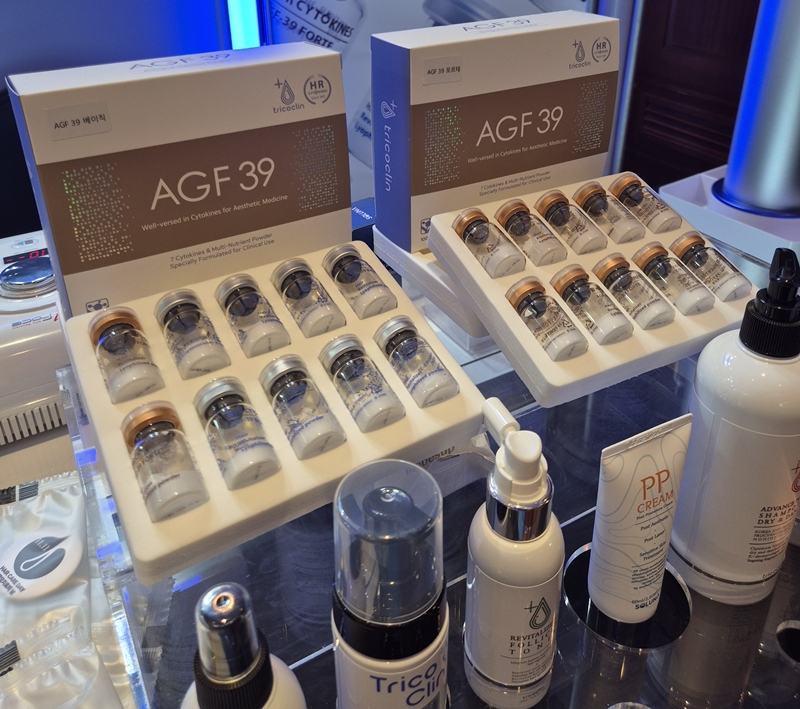
This post introduces SGF57, the original product that serves as the blueprint behind AGF39 not as a marketing claim, but as a story anchored in how evidence is created and accumulated over time. In the next posts of this series, we will walk through clinical research, scientific presentations, and peer-reviewed publication that shaped this legacy.

Why “Growth Factors + Delivery” Matters in Hair Care
When people hear “growth factors,” they often imagine a single magic ingredient. In reality, hair biology is influenced by multiple signaling pathways, and that is why many approaches focus on a combination of bioactive proteins rather than a single target.
However, composition alone is not enough. A second challenge is equally important:
- How do we deliver active proteins to the scalp environment where they may matter?
This is where microneedling delivery enters the conversation. The logic is straightforward: microneedling can create micro-channels across the stratum corneum, potentially improving topical penetration. In the SGF57 research context, microneedling was used explicitly to enhance delivery, and the observed effects were discussed as being linked to this penetration advantage.
So, the SGF57 concept can be summarized as:
- Multi-factor composition
- Plus a delivery method designed to support penetration
- Measured with objective imaging tools
That combination – composition plus delivery plus measurement – became the starting point of the evidence trail that later supported broader frameworks.

From Concept to Clinical: How SGF57 Was Built
1) A multi-factor formula designed around hair-related signaling
In the peer-reviewed study associated with SGF57, the topical solution included a set of major components such as:
- basic fibroblast growth factor (bFGF)
- insulin-like growth factor-1 (IGF-1)
- vascular endothelial growth factor (VEGF)
- stem cell factor (SCF)
- keratinocyte growth factor-2 (KGF-2)
- superoxide dismutase-1 (SOD-1)
- Noggin
Importantly, the paper describes these as target proteins produced under controlled conditions (e.g., KGMP facility and expression system details).
For readers, the practical takeaway is not the lab technique itself, but the intent: a controlled, repeatable composition as the foundation for clinical testing.
2) Delivery as a clinical variable, not an afterthought
In the same clinical work, the protocol used microneedling with:
- 0.5 mm depth
- constant rotational speed (1500 rpm)
- weekly sessions for five treatments
This matters because a formula can only be meaningfully evaluated if the delivery method is consistent. SGF57 was not presented as “a topical used in any way.” It was studied with a defined procedure.
3) Measurement that can be repeated
Hair outcomes can be subjective without standardized tools. The study employed:
- standardized photography conditions
- phototrichogram imaging using a digital microscope
- hair shaft counts performed by a blinded investigator
This emphasis on measured outcomes is one of the reasons SGF57 became a meaningful “origin story” rather than a generic product narrative.

What This Series Will Prove (Clinical → Conference → Journal)
This blog series is built around a simple timeline: clinical evaluation → conference dissemination → peer-reviewed publication.
Step 1: Clinical evaluation (peer-reviewed journal evidence)
In a scalp-split, single-blinded, placebo-controlled trial design, growth factor solution was applied to one half of the scalp and compared with saline on the other half both followed by microneedle therapy.
Key outcome signals reported include:
- hair shaft density differences becoming significant at several time points
- an increase of more than 10% compared with baseline observed on the treated side
- no adverse reactions related to the treatment
This does not mean “guaranteed results for everyone.” It means that within a defined pilot setting, measurable improvement was observed under a controlled method exactly the kind of starting point a serious clinical story needs.
Step 2: Conference presentations (expanding experience and refining parameters)
Conference posters often serve a practical role: sharing real-world clinical experience and identifying what to refine next.
In the WCHR 2013 poster context, the treatment approach is described as topical application of a growth factor solution using microneedle therapy and electroporation, with phototrichogram evaluation and multiple sessions across months.
The summary also notes safety observations such as no adverse effects except mild tingling sensation.
Then, the 2014 WCHR poster focuses on a key practical question:
- What microneedle depth is most effective?
In that split-scalp comparison, one side used 0.5 mm and the other 0.3 mm, with density and thickness measured by phototrichogram in a fixed tattoo-marked area.
The poster concludes that 0.5 mm depth seems more effective than 0.3 mm, and calls for further research.
Step 3: Why peer-reviewed publication matters
A peer-reviewed journal is not just a trophy. It forces clarity in:
- Protocol
- Measurement
- reporting of adverse events
- limitations
This is why SGF57’s credibility story is not built on a single marketing sentence. It is built on the way evidence is documented and shared.

How This Legacy Connects to AGF39 (Without Overclaiming)
SGF57 is best understood as the original blueprint – the starting formulation and evidence pathway that informs how AesMed thinks about reliability.
When we say “SGF57 is the original behind AGF39,” the most responsible interpretation is:
- an evidence-first philosophy
- a repeatable approach to composition + delivery
- a commitment to measured outcomes
- and a history of clinical and academic communication
In the next posts, we will translate the evidence into a reader-friendly summary:
- Post 2: the peer-reviewed clinical study and what it actually measured
- Post 3: what the conference posters added, including depth optimization and real-world insights
If you care about hair care credibility, this is the direction worth following: from concept to clinical, and from claims to measurements.

Key Terms Glossary (Quick Definitions)
- Growth factors: bioactive proteins that can influence cellular signaling related to tissue and follicle biology.
- Microneedling delivery: a method using micro-needles to create micro-channels in the skin, potentially enhancing topical penetration.
- Phototrichogram: an imaging-based method to measure hair parameters (e.g., density, thickness) in a defined scalp area.
- Scalp-split study: each participant acts as their own control by comparing left vs right scalp areas.
- Placebo-controlled: compares an active approach to a non-active control (e.g., saline).
- Single-blinded: one party (e.g., evaluator) is blinded to reduce bias.
- Needle depth (0.5 mm vs 0.3 mm): a practical parameter tested in conference research to compare outcomes.
If you would like an evidence-focused briefing on SGF57’s clinical protocol, measurement approach, and conference findings, please contact AesMed for professional materials and consultation.

“Some of the images were created using Miricanvas and Gemini.”